However litigation is not the only process for dispute resolution. Mediation and Arbitration have become much more commonly used in recent years and in some instances preferred as a process that is both cheaper and quicker than full court litigation. This has enabled locations such as Jakarta and Kuala Lumpur to complete as the venue for dispute resolution and their influence should not be ignored.
Singapore remains the primary location for large scale litigation and the country has spent considerable amount of capital and resources on the development of all the necessary parts of the jigsaw. They have a main Supreme Court building designed by Norman Foster & Partners. It “is organised to reflect the hierarchies of the judicial system. Its twelve civil courts, eight criminal courts, three appeal courts and Academy of Law facilities form a series of identifiable blocks, cut through with public arcades. The Court of Appeal is symbolically raised above all the others, occupying a disc-like form at the top of the building – a ‘space-age’ iteration of the classical courthouse dome, clad in dark grey aluminium panels with tinted glass windows. The rest of the building is clad in ‘rosa aurora’ marble – a translucent stone that articulates the concept of the transparency of Singaporean justice.” (Source: Aga Khan Trust for Culture). The Supreme Court is located immediately behind the National Gallery and next to the parliament building giving an indication of the importance of its function.
Singapore has also invested in highly capable judges, advocates, lawyers and systems for online filing and case management that underline the High Court and Singapore International Commercial Court (‘SICC’) which are the initial point of access for major civil disputes.
Singapore has also become a major financial centre with many international banks as well as some large domestic ones based there. Of the international banks; HSBC, Standard Chartered and Deutsche Bank maintain large offices there. It is no surprise that Singapore has been a particular focus for Expert Evidence because due to the number of major financial cases that have been brought in both the High Court and the SICC. Expert Evidence has provided expert reports in cases in both courts and appeared and given evidence under cross examination. The location was also chosen by the Expert Witness Institute as a suitable location for a branch office for the training and assistance of experts operating in the Asian courts, Tribunals, Mediations and Arbitrations.
Singapore also operates an active oversight of the conduct of the financial markets under the eye of the Monetary Authority of Singapore (‘MAS’) and the Attorney General of Singapore (‘AG’). Both the MAS and the AG have been keen to ensure that the financial markets in Singapore remain clean by world standards and that the efficiency of the markets can be relied on. This has led to a number of criminal cases for market abuse, insider trading and fraud.
In common with other major legal centres, Singapore operates a series of requirements for Expert Witnesses when they are giving evidence and attending trial. The primary rules are provided in Evidence Act – Opinions of third persons when relevant, Criminal Procedure Code – Report of qualified persons, Rules of the Court Order 12, Rules of the Court Order 40, 40A, and Practice Direction for the Singapore International Commercial Court. In Hong Kong the situation is not dissimilar which has published the Rules of the High Court.
In common with the Middle East a comprehensive understanding of local cultural issues is an important factor in understanding legal disputes that arise in cases here.
Expert Evidence has conducted seminars in Singapore and many of the major law firms that operate as a “Singaporean Magic Circle”, the Law Society of Singapore and the Academy of Law to explain the contribution of experts to lawyers, the operation of a case, how to instruct an expert witness, and the conduct of an experts’ meeting.
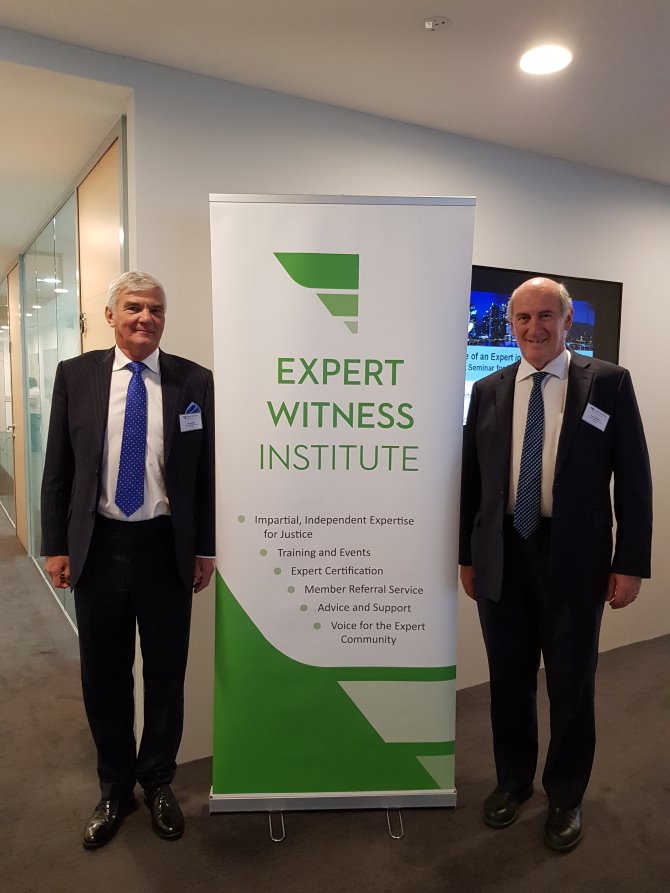
In common with other major legal centres, Singapore operates a series of requirements for Expert Witnesses when they are giving evidence and attending trial. The primary rules are provided in Evidence Act – Opinions of third persons when relevant, Criminal Procedure Code – Report of qualified persons, Rules of the Court Order 12, Rules of the Court Order 40, 40A, and Practice Direction for the Singapore International Commercial Court. In Hong Kong the situation is not dissimilar which has published the Rules of the High Court.
In common with the Middle East a comprehensive understanding of local cultural issues is an important factor in understanding legal disputes that arise in cases here.
Expert Evidence has conducted seminars in Singapore and many of the major law firms that operate as a “Singaporean Magic Circle”, the Law Society of Singapore and the Academy of Law to explain the contribution of experts to lawyers, the operation of a case, how to instruct an expert witness, and the conduct of an experts’ meeting.